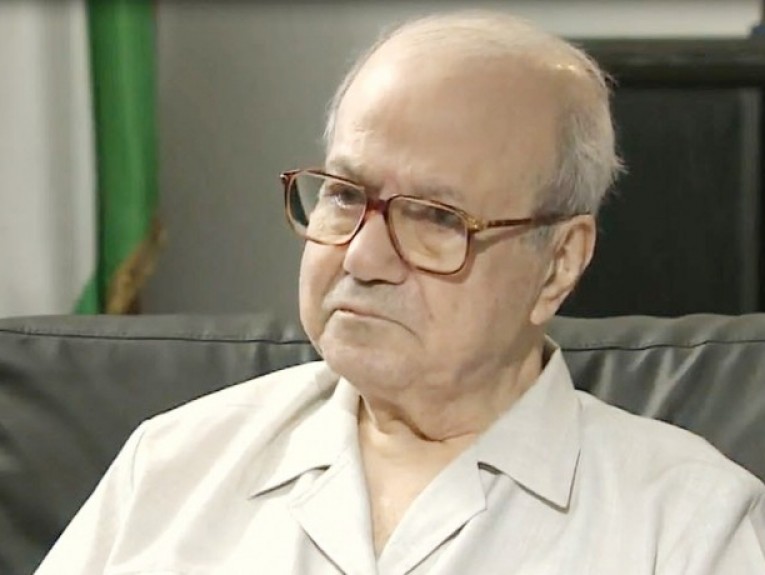
Birth: NULL/NULL/1931 Death:NULL/NULL/NULL
Born in Jinsafut in the Qalqilya district on 18 Aug. 1931; grew up in Jaffa; was uprooted during the 1948 Nakba and left with his family, wandering in several Arab countries, incl. Lebanon, where Qaddumi graduated from high school; joined the Ba’ath Party (left it after the break-up of the United Arab Republic in 1961); studied Economics and Political Science at the AUC, where he became a student activist and where he first met Yasser Arafat; then sought work in the Arab oil-exporting countries, first Libya, then Saudi Arabia, where he worked as a personnel officer for ARAMCO, and finally Kuwait, where he arrived in 1957 and got a clerk’s position at the Ministry of Health (until he was expelled in 1966 by the Kuwaiti government as part of its policies to minimize the number of Palestinians fearing that they might create a state within a state); founding member of Fateh in 1959 and in charge of improving ties with Egypt and between Fateh leaders and Pres. Abdel Nasser; early member of the PLO; was at Arafat’s side during the Battle of Karameh in March 1968; served on the PLO’s Executive Committee since Fateh took over the PLO in 1969; resettled in Damascus, from where he helped establishing ties between the PLO and Arab countries; named as member to the PLO Exec. Committee in 1969; was arrested and jailed by Jordan during the 1970 Black September events; then moved with the PLO to Beirut; in 1973, was assigned by Arafat to head the PLO Political Dept., replacing the assassinated Mohammed Yousef An-Najjar, and took charge of foreign affairs (opened, among other things, over 100 PLO missions in foreign countries during his career); played a major role since the mid-1970s developing contacts with the USA (which led to their recognition of the Palestinian right to self-determination), Arab States and European countries; gained the recognition of the PLO as sole representative of the Palestinians in many countries which resulted in the opening of PLO offices in European capitals and the granting of diplomatic status for its representatives; remained an advocate of Syria even after Yasser Arafat’s relationship with it deteriorated in the wake of the 1982 Israeli invasion of Lebanon; moved to Tunisia with the PLO in 1982; became Sec.-Gen. of the Fateh Central Committee in 1983; was elected Palestinian Foreign Minister by a PLO Central Council meeting in Tunis in 1989; opposed the Oslo process and refused to sign the DoP (was then replaced by Mahmoud Abbas); abstained from voting for the accords at the PLO Central Committee meeting in Tunis in Oct. 1993; refused to enter the PA areas or to hold any office within the PA, but accepted a post as formal head of PECDAR (the Palestinian Economic Council for Development and Reconstruction); in Jan. 1994, signed an Economic Cooperation Agreement on behalf of the PLO with Jordanian Deputy PM Sa’id At-Tal and Egyptian FM Amr Musa, giving their respective Central Banks supervisory powers over Jordanian/Egyptian banks operating in the West Bank; strongly criticized Oslo II at the PLO Exec. Committee meeting in Tunis in Aug. 1995; one of nine PLO Exec. Committee members who signed a statement rejecting the Oslo II Agreement on 4 Oct. 1995; nominally second in command of the PLO; following the death of Yasser Arafat, was appointed head of Fateh; remains PLO politburo chief and the PLO’s Foreign Minister.