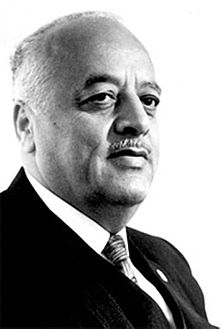
Birth: NULL/NULL/1908 Death:NULL/NULL/1980
Born in Tibnin, South Lebanon, in 1908, during his father’s – Sheikh As’ad Al-Shuqeiri – exile; spent his childhood in Lebanon, Tulkarem, and then in Acre, where he completed primary school; continued schooling in Jerusalem until 1926; began to study Law at the AUB but was expelled by the French authorities for his participation in a student demonstration; returned to Jerusalem, studied at the Jerusalem Law School, and worked for Mir’at Ash-Sharq newspaper; was the opposition leader in the north of Palestine in the early 1930s; after graduation worked at the office of Awni Abdul Hadi; was a member of the Istiqlal Party; became actively involved in the nationalist movement and struggled against British rule and the Zionists; was persecuted by the British for his role in the 1936-39 Arab Revolt and left to Egypt; returned to Palestine at the beginning of WWII and opened his own law office in Acre, specializing in defending nationalist militants and in land issues; became head of the first Palestinian Arab Media office in Washington, DC, in 1945; in 1946, became member of the reconstituted Arab Higher Committee and head of the Central Arab Media Office in Jerusalem; took with his family refuge in Beirut, Lebanon, in 1948; was appointed member of the Syrian delegation to the UN from 1949-50; served as Assistant Sec.-Gen. of the Arab League in charge of Palestinian affairs from 1951-57; was appointed Saudi Arabian Minister of State for UN Affairs and Ambassador to the UN from 1957-63; addressed the UN on the Palestinian Refugee Problem in 1958, saying, that “the rights of the refugees to their homes and homeland are not related to, or in any way dependent upon, the consent or refusal of Israel;” was appointed by the heads of the Arab states in Sept. 1963 as Palestinian representative to the Arab League (replacing Ahmad Hilmi Abdel Baqi who had died); was officially entrusted to that post at the 1st Arab Summit held in Jan. 1964; drew the first draft of the Palestinian National Charter which became the Basic Law for the establishment of the PLO; announced the establishment of the PLO at the PNC held from 28 May-2 June 1964 in Jerusalem and was subsequently elected first Pres. of the PLO; was also elected Chairman of the first PLO Exec. Committee established in Aug. 1964; formed the PLA; considered armed struggle as the only means to the liberation of Palestine; resigned as head of the PLO in Dec. 1967, over differences among the Exec. Committee members following the June 1967 War (was replaced by Yahya Hamudeh); stayed away from official posts and devoted his time to writing, living alternately in Cairo and Lebanon; wrote several books on Arab and Palestinian issues and published, in 1969, his memoirs entitled Forty Years of Arab and International Life (Beirut, 1969); considered the 1978 Camp David Accords and subsequent 1979 Egyptian-Israeli Peace Treaty as high treason towards the Arab and Palestinian cause and left Cairo for Tunisia; later moved to Amman for medical treatment; died on 26 Feb. 1980 in Amman; was buried upon his request in the cemetery of Abu Obeida in the Jordan Valley (East Bank).