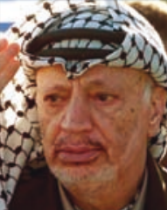
Birth: 4/8/1929 Death:11/11/2004
Born in Jerusalem (or Cairo) on 4 Aug. 1929 as Abdul Rahman Abdul Ra’uf Arafat Al-Qudwa Al-Husseini; grew up mainly in Cairo and, for a brief period, in Jerusalem; fought in 1948 alongside the Palestinian defense forces under Mufti Haj Amin Al-Husseini; graduated from Cairo University, Faculty of Engineering, in 1956; founder and president (1952-57) of the GUPS in Cairo/Egypt; founder and chairman of the Union of Palestinian Graduates in 1956; volunteered in the Egyptian army during the 1956 Suez Canal crisis; left to Kuwait in late 1956; co-founder (with Khalil Al-Wazir) of the first Fateh cell in 1957; founder of the Fateh movement and its leader since 1958; member of the first Palestinian delegation to China to confer with Premier Chou‑En‑Lai in March 1964; Fateh spokesperson since 1968; fought in the Karameh battle in 1968; elected Chairman of the PLO Exec. Committee in Feb. 1969 when Fateh became the dominant force in the PLO (remained in this position until his death); changed the directions of the PLO from being pan-Arabist organization to one focusing on the Palestinian national cause; was appointed Commander-in-Chief of the all-Palestinian/Arab guerilla forces in Sept. 1970; agreed to ‘liberate Palestine by stages’ at the 1974 PNC conference in Cairo; addressed the UNGA in New York for the first time on 13 Nov. 1974, delivering his famous speech saying he bore an olive branch (for peace) in one hand, and a gun (for war) in the other; rejected Egyptian Pres. Anwar Sadat’s peace talks with Israel during 1977-78 (Camp David), after it became clear that its version of Palestinian autonomy fell far short of statehood, and gave no role to the PLO; signed a joint Jordanian-Palestinian agreement on a peace framework with King Hussein of Jordan, in 1985, encompassing plans for a Palestinian-Jordanian confedera‑tion (which was abrogated in 1986); in March 1986, offered to accept UN Res. 242 and 338, and thus Israel, in exchange for a guarantee by the permanent UNSC members that Palestinians will be able to exercise their right to self-determination; delivered a speech at the 19th PNC in Algiers on 15 Nov. 1988, recognizing Israel, renouncing terrorism and proclaiming the independent Palestinian State; was elected by the PLO Central Council as the first President of the State of Palestine on 2 April 1989; offered his ‘good offices’ to negotiate an Arab solution to the 1990-91 Gulf Crisis, after Saddam Hussein’s ‘call to arms’ on behalf of Palestine; announced his marriage to Suha Tawil in Feb. 1992; survived an air crash over the Libyan Sahara in April 1992; supervised secret negotiations with Israel from 1992 which led to the signing of the DoP between PLO and Israel on 13 Sept. 1993; since then negotiating with Israel on Palestinian self-rule; returned to Palestine on 1 July 1994; set up the PA and appointed himself as President, Minister of Interior and Minister of Religious Affairs; was awarded the Nobel Prize for Peace together with Israeli PM Yitzhak Rabin and FM Shimon Peres in 1994; was elected President of the PA in the Jan. 1996 elections (with 87.3% of the vote); appointed a committee to draw up a Palestinian constitution; met Pres. Clinton during his first official visit to the US in May 1996; announced a new 25-member cabinet on 9 May 1996; faced with resignations from the PLC and his cabinet in 1997-98 (e.g., Hanan Ashrawi and Haidar Abdul Shafi) over his failure to implement reforms and combat corruption; received the “Golden Pegasus” prize in Florence in June 1998; signed the Wye River Plantation Agreement with Israel in October 1998, calling for further Israeli withdrawals and a Palestinian crackdown on militants; in 1999, threatened to unilaterally declare a Palestinian state in the WBGS with East Jerusalem as its capital, at the end of the interim period laid down in the Oslo Accords, following Israel’s failure to meet its commitments, but was persuaded against this; signed the Sharm Esh-Sheikh Agreement in Sept. 1999, which called for a further land transfer of ‘Area C’ to ‘Area B’; headed the negotiations in Camp David with Pres. Clinton and PM Barak in July 2000, taking a firm stand on the questions of Jerusalem and the refugees, and was held responsible by Israel and the US when no agreement was reached; increasingly marginalized by the Israeli govt. following the election of right-wing PM Ariel Sharon in Feb. 2001, who refused to meet or deal with him; banned from traveling and confined to his compound (the Muqata’a) in Ramallah by the Israeli army for much of the Al-Aqsa Intifada; accepted under international pressure to appoint a PM in Feb. 2003, and swore in Mahmoud Abbas as first ever PM in April 2003; after Abbas’ resignation, announced an PA Emergency Govt. in early Oct. 2003; swore in the subsequent govt. of the new PM Ahmed Qrei’a govt. on 12 Nov. 2003; turned seriously ill in Oct. 2004 and was flown from Ramallah to Paris via Amman to receive further medical treatment on the suspicion of suffering from a potentially fatal blood disorder, marking the first time he went abroad since 2001; underwent medical checks and treatment at the Percy Military Teaching Hospital in Clamart, outside Paris, from 29 Oct. 2004 but failed to recover and was pronounced dead on 11 Nov. 2004, ending days of rumors over his condition; received an honorary farewell in France, a state funeral ceremony in Cairo and was the buried in the Muqata’a in Ramallah on 12 Nov. 2004. Will be dearly remembered by his people for forcing their plight into the world spotlight, devoting his life to the quest for Palestinian statehood, and unified them in their struggle for national freedom and independence.